杨涛,研究员,博士生导师, 中科院“百人计划”入选者。1997年毕业于日本德岛大学,获工学博士。博士毕业后,作为研究员或助理教授曾先后任职于日立公司中央研究所,新能源产业技术综合开发机构(NEDO)和东京大学。2006年,作为中科院“引进海外杰出人才”回国到半导体研究所工作。
本页面主要目录有关于杨涛的:研究领域、代表性研究工作、科研项目、代表性论著等介绍

杨涛,研究员,博士生导师, 中科院“百人计划”入选者。1997年毕业于日本德岛大学,获工学博士。博士毕业后,作为研究员或助理教授曾先后任职于日立公司中央研究所,新能源产业技术综合开发机构(NEDO)和东京大学。2006年,作为中科院“引进海外杰出人才”回国到半导体研究所工作。
本页面主要目录有关于杨涛的:研究领域、代表性研究工作、科研项目、代表性论著等介绍
杨涛
中华人民共和国
男
研究员
杨涛博士长期从事半导体材料、器件与物理研究,尤其在氮化物半导体新材料、光子晶体和纳米结构半导体量子点材料及器件应用等前沿领域中取得了多项创新性成果。
1)理论上建立了适于III族氮化物半导体电子能带结构计算的紧束缚近似模型。该模型被国际同行称作“标准的紧束缚近似模型”;
2)基于此模型给出了III族氮化物合金材料的能带图、禁带、电子有效质量等表征其物理特性的重要物理量。这些物理量对基于III族氮化物半导体材料的光电子器件的设计与模拟,材料物理特性的实验研究等具有重要意义;
3)理论上证明了V族立方相氮化物合金(InAsN)具有大的带隙弯曲参量,预言此材料可作为发展长波长信息功能器件的新材料;
4)提出了“高温缓冲层”概念,用“三步生长法”取代“传统的两步生长法”在蓝宝石衬底上用MOCVD制备出高质量GaN晶体。这对于发展GaN基的光电子器件具有重要的现实意义;
5)近年,主要致力于低维半导体量子点材料与器件应用的研究并取得了一系列成果:如,在国际上证明了最均匀的1.3微米辐射InAs/GaAs自组织量子点材料(非均匀展宽<17 meV);报道了快速退火能使长波长量子点产生大的波长蓝移现象,阐明了产生这一现象的物理机理;在国内实现了无外部致冷、高速(10 Gb/s)、直接调制的1.3微米GaAs基量子点激光器,报道了基于InAs/GaAs量子点材料的中间能带太阳能电池等。
1)国家重大科学研究计划项目“新型半导体纳米线的可控生长和表征” (2012-2016);
2)国家自然科学基金项目“基于MOCVD高性能1.55微米InAs/InP自组织量子点材料生长及激光器应用研究”(2012-2015);
3)国家自然科学基金项目“新型高效InAs/GaAs量子点中间能带太阳能电池的研究”(2011-2013);
4)国家自然科学基金项目“新型P型掺杂1.3微米InAs/GaAs自组织量子点材料生长及激光器应用相关基础研究”(2009-2011);
5)中科院百人计划项目“低维半导体量子点材料和器件应用研究”(2007-2010);
6)国家863计划项目“新型P型掺杂GaAs基1.3微米InAs量子点激光器研究”(2006.12 - 2008.12)。
1) P. F. Xu, H. M. Ji, T. Yang*, B. Xu, W. Q. Ma, and Z. G. Wang, “The Research Progress of Quantum Dot Lasers and Photodetectors in China”, Journal of Nanoscience and Nanotechnology, Vol.11(2011), pp. 9345-9356.
2) Y. X. Gu, T. Yang*, H. M. Ji, P. F. Xu, and Z. G. Wang, “Redshift and discrete energy level separation of self-assembled quantum dots induced by stain-reducing layer”, J. Appl. Phys. Vol. 109 (2011), pp. 064320-064324.
3) P. F. Xu, T. Yang*, H. M. Ji, Y. L. Cao, Y. X. Gu, and Z. G. Wang, “Temperature compensation for threshold current and slope efficiency of 1.3 mm InAs/GaAs quantum-dot lasers by facet coating design”, Chin. Phys. Lett. Vol. 28 (2011) pp. 044201-044203.
4) X. G. Yang, T. Yang*, K. F. Wang, Y. X. Gu, H. M. Ji, P. F. Xu, H. Q. Ni, Z. C. Niu, X. D. Wang, Y. L. Chen, and Z. G. Wang, “Intermediate-band solar cells based on InAs/GaAs quantum dots”, Chin. Phys. Lett. Vol. 28 (2011) pp. 038401-038403.
5) H. M. Ji, T. Yang*, Y. L. Cao, P. F. Xu, Y. X. Gu, and Z. G. Wang, “Self-Heating Effect on the Two-State Lasing Behaviors in 1.3 μm InAs–GaAs Quantum-Dot Lasers”, Jpn. J. Appl. Phys. Vol. 49 (2010) pp. 072103-072106.
6) Y. L. Cao, T. Yang*, P. F. Xu, H. M. Ji, Y. X. Gu, X. D. Wang, Q. Wang, W. Q. Ma, Q. Cao, and L. H. Chen, “Delay of the excited state lasing of 1310 nm InAs/GaAs quantum dot lasers by an optimal facet coating”, Appl. Phys. Lett. Vol.96 (2010) pp. 171101-171103.
7) H. M. Ji, T. Yang*, Y. L. Cao, P. F. Xu, Y. X. Gu, Y. Liu, L. Xie, and Z. G. Wang, “A 10 Gb/s directly-modulated 1.3 μm InAs/GaAs quantum-dot Laser”, Chin. Phys. Lett. Vol. 27 (2010) pp. 034209-034211.
8) H. M. Ji, T. Yang*, Y. L. Cao, P. F. Xu, Y. X. Gu, W. Q. Ma, and Z. G. Wang, “High characteristic temperature 1.3 μm InAs/GaAs quantum-dot lasers grown by molecular beam epitaxy”, Chin. Phys. Lett. Vol. 27 (2010) pp. 027801-027803.
9) P. F. Xu, T. Yang*, H. M. Ji, Y. L. Cao, Y. X. Gu, Y. Liu, W. Q. Ma, and Z. G. Wang, “Temperature-Dependent Modulation Characteristics for 1.3 mm InAs/GaAs Quantum Dot Lasers”, J. Appl. Phys. Vol.107 (2010) pp. 013102- 013106.
10) Y. L. Cao, T. Yang*, H. M. Ji, W. Q. Ma, Q. Cao, and L. H. Chen, “Temperature sensitivity dependence on cavity length in p-type doped and undoped 1.3 mm InAs/GaAs quantum dot lasers”, IEEE Photon. Technol. Lett. Vol. 20 (2008) pp. 1860-1862.
11) T. Yang, J. Tatebayashi, K. Aoki, M. Nishioka, and Y. Arakawa, “Effects of rapid thermal annealing on the emission properties of highly uniform self-assembled InAs/GaAs quantum dots emitting at 1.3 µm”, Appl. Phys. Lett. Vol.90 (2007) pp. 111912- 111914.
12) T. Yang, J. Tatebayashi, M. Nishioka, and Y. Arakawa, “Improved surface morphology of stacked 1.3 µm InAs/GaAs quantum dot active regions by introducing annealing processes”, Appl. Phys. Lett. Vol.89 (2006) pp. 081902-081904.
13) T. Yang, S. Tsukamoto, J. Tatebayashi, M. Nishioka, and Y. Arakawa, “Improvement of the uniformity of self-assembled InAs quantum dots grown on InGaAs/GaAs by low-pressure metalorganic chemical vapor deposition”, Appl. Phys. Lett. Vol.85 (2004) pp. 2753-2755.
14) T. Yang, J. Tatebayashi, S. Tsukamoto, M. Nishioka, and Y. Arakawa, “Narrow photoluminescence linewidth (< 17 meV) from highly uniform self-assembled InAs/GaAs quantum dots grown by low-pressure metalorganic chemical vapor deposition”, Appl. Phys. Lett. Vol.84 (2004) pp. 2817-2819.
15) T. Yang, Y. Sugimoto, S. Lan, N. Ikeda, Y. Tanaka, and K. Asakawa, “Transmission properties of coupled cavity waveguides based on two-dimensional photonic crystals with a triangular lattice of air holes”, J. Opt. Soc. Am. B Vol.20 (2003) pp. 1922-1926.
16) T. Yang, S. Kohmoto, H. Nakamura, and K. Asakawa, “Effects of lateral quantum dot pitch on the formation of vertically aligned InAs site-controlled quantum dots”, J. Appl. Phys. Vol.93 (2003) pp. 1190-1194.
17) T. Yang, T. Ishikawa, S. Kohmoto, Y. Nakamura, H. Nakamura, and K. Asakawa, “Height control of InAs/GaAs quantum dots by combining layer-by-layer in situ etching and molecular beam epitaxy”, J. Vac. Sci. Technol. B Vol. 20 (2002) pp. 668-672.
18) T. Yang, K. Uchida, T. Mishima, J. Kasai, and J. Gotoh, “Control of initial nucleation by reducing the V/III ratio during the early stage of GaN growth”, Phys. Status Solidi (a) Vol. 180 (2000) pp. 45-50.
19) T. Yang, S. Goto, M. Kawata, K. Uchida, A. Niwa, and J. Gotoh, “Optical properties of GaN thin films on sapphire substrates characterized by variable-angle spectroscopic ellipsometry”, Jpn. J. Appl. Phys., Part 2 Vol. 37 (1998) pp. L1105-L1108.
20) T. Yang, S. Nakajima, and S. Sakai, “Tight-binding calculation of electronic structures of InNAs ordered alloys”, Jpn. J. Appl. Phys., Part 2 Vol. 36 (1997) pp. L320-L322.
21) T. Yang, S. Nakajima, and S. Sakai, “Electronic structures of wurtzite GaN, InN and their alloy Ga1-xInxN calculated by the tight-binding method”, Jpn. J. Appl. Phys., Part 1 Vol. 34 (1995) pp. 5912-5921.

新亚洲娱乐(英文名:ASIA ENTERTAINMENT GROUP LIMITED,全称:新亚洲娱乐联盟集团有限公司)是一家以从事戏剧制作人及杂项戏剧服务为主的企业,成立于1999年,位于香港特别行政区。旗下分公司包括虎威艺能创作有限公司(TGS HK)、稻草人娱乐创作社(Scarecrow Entertainment)、虎威王朝音乐创作股份有限公司(TGS Music)、虎威活力娱乐传播有限公司(TGS Taiwan)、AK Entertainment(Korea)以及AEG Korea等。
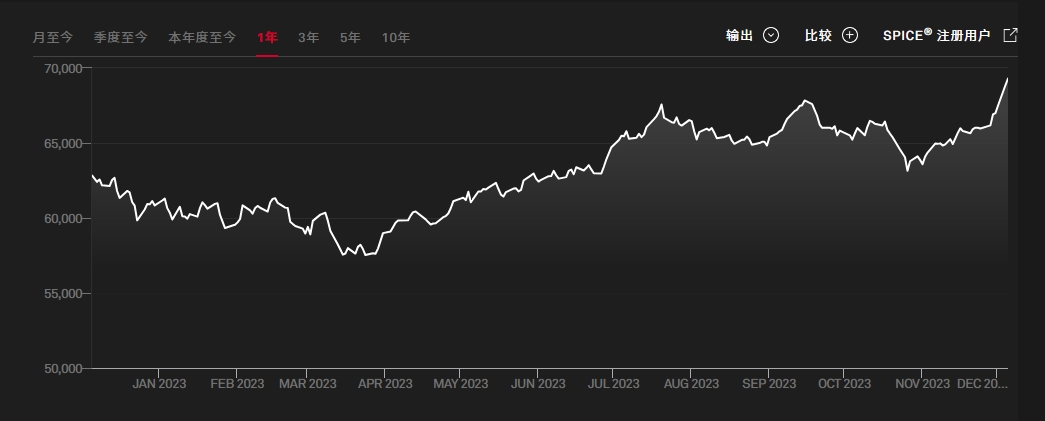
印度孟买SENSEX30指数(又称孟买敏感指数)为印度最被广泛使用的指数,为投资印度的重要参考指标,是由孟买证券交易所发行。由于各类媒体提到的“印度股市”,实际上都是孟买股票交易所,因此,该交易所的SENSEX-30指数几乎成了印度股市的代名词。